Showing posts with label John Keats. Show all posts

Thursday, September 1, 2022

A Thing of Beauty

"A thing of beauty is a joy forever," so starts John Keats's long poem Endymion. Keats himself was part of that era of appreciating beauty, particularly classical beauty and that found in nature. The pursuit of beauty of the Romantic poets, though not flawless, was at least more pure than that of the aesthetes. I don't think Oscar Wilde appreciated the types of things John Keats appreciated. Keats, at least, could appreciate a good nature walk.

You know, I've wandered through the McDowell Sonoran Preserve plenty of times in my day. But it took many visits before I happened to look to the side at the Gateway Trailhead and see a small stone, like a gravestone, with those very same Keats words carved on it: "A thing of beauty is a joy forever." Fitting words for a nature preserve, a section of land deliberately set aside for the preservation of its beauty. Keats probably never saw a saguaro or a creosote or an ocotillo. So perhaps it's a little random to include a John Keats quote in the Sonoran Desert. But I, for one, do not mind bringing some of the, let's call it, classical perspective into how we approach the desert today. 
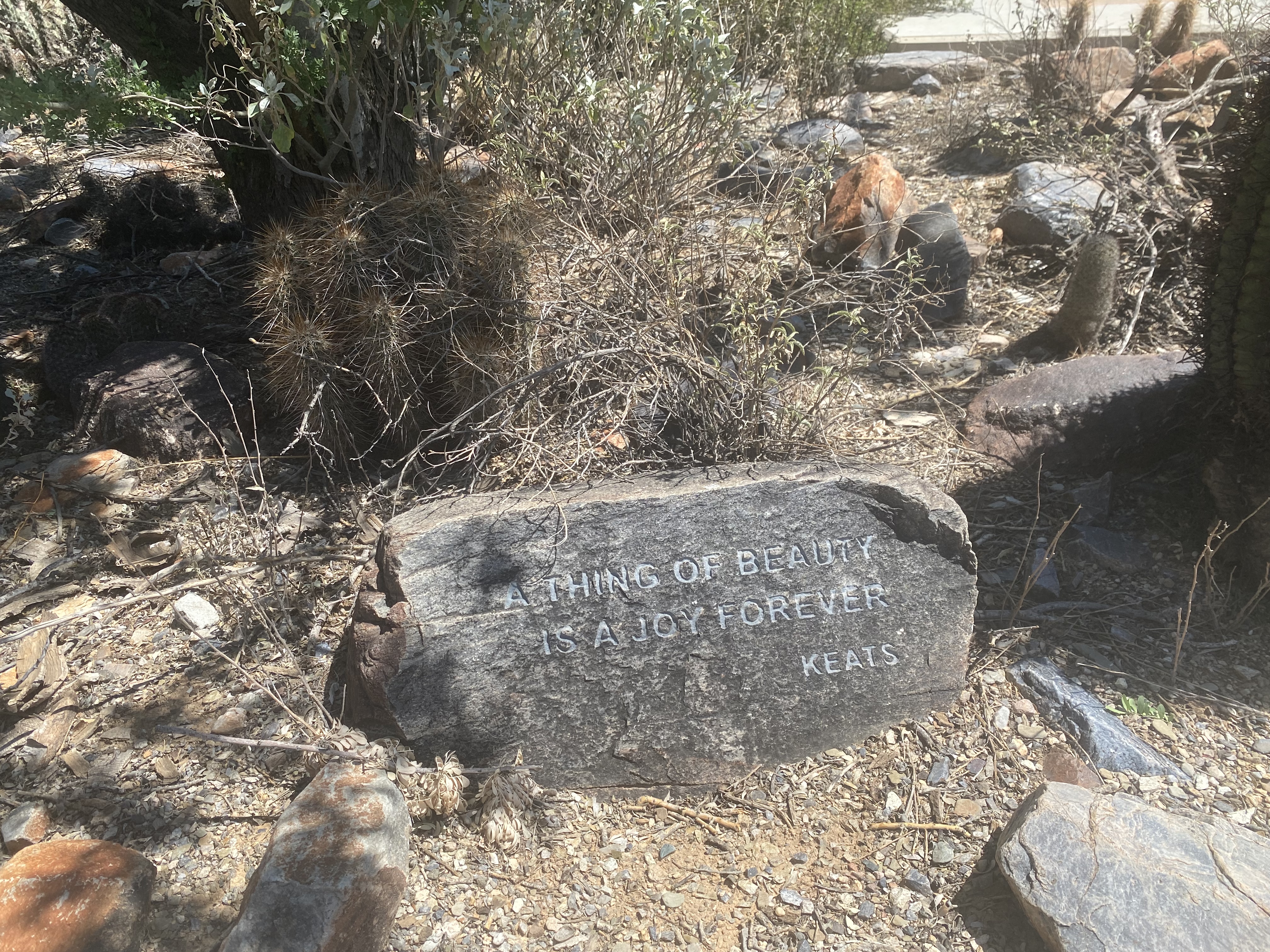

Keats wrote his "Ode to a Nightingale" in a completely different natural setting than the one in which I live. Yet I can sit and listen to the mourning doves and watch the quail go by in a similar state--the sort of melancholy ecstasy that he so well describes. I'm an advocate for enjoying whatever it is that you're able to enjoy where you are. Not that I wouldn't enjoy a trip to England. But I don't believe that beauty is so limited that I can only find it in certain places. 

Like that Keats stone at the trailhead. I only had to take a look, to let my eye linger, to not rush by in order to see it. Don't rush by the hidden odes to English poets. Don't rush by the patch of late summer wildflowers. Don't rush by the extended greenery of the landscape after rain. Don't rush by the tortoise walking the edge of the path. Don't rush by the sparkle of starlight. Don't rush by the fingernail of the moon. Don't rush by the perfect shape of each leaf of that cultivated shrub on that cultivated landscape surrounding that city building. 

For, after all, "a thing of beauty is a joy forever." The city building will not last. The cultivated landscape and shrub won't, either. But the shape of that leaf, crafted by the best designer, will not fade. There will be another leaf on another plant somewhere that will be its match, still crafted in such perfection. Even statues and vases that have been beloved for generations, well, sometimes they are destroyed. The memory of their loveliness sometimes does pass away. And so it is that the loveliness that continues to increase, as Keats describes it, I would say is that found in nature. It is nature that we can keep turning to with joy and awe. And its loveliness increases as our appreciation increases. Stay and linger and breathe it in. 

Wednesday, July 17, 2019

"Beauty Is Truth"

Today is all about "Ode on a Grecian Urn" by John Keats. Ha, ha, you know what kind of mood I'm in when I'm bringing out John Keats, the one who whispers intoxicatingly beautiful poetry in the ears of writers and lit students.

I didn't get this poem the first time I read it because I didn't know the context. I didn't know anything about Keats or the Romantics. So it was just a guy reflecting on the imagery on a Grecian urn. And that infamous line at the end ("Beauty is truth, truth beauty") I thought was a comment about aesthetics. But the Romantics were not the Aesthetes and John Keats was not Oscar Wilde. Yet even after I learned about context and Keats's commentary and theories on art, this poem remained less interesting to me than pieces like "Ode on Melancholy" or "Ode to a Nightingale" or "Bright Star." I used to keep "Bright Star" written out above my desk . . . maybe I'll do that again.

Now, though, I have finally felt "Ode on a Grecian Urn." In a single poem, Keats contains the pain of life and also its opposite. Would you call that opposite pleasure? No, not quite right. Beauty, yes, truth, yes, those words work.

It can seem as though the narrator is describing aesthetic beauty because he is describing the visuals that are on the urn. In fact, though, he describes things felt, most notably of course the love between the lovers. So when he speaks of beauty, he isn't just describing the aesthetics that are portrayed by the urn: he is describing the sentiments that the visuals express. That is the beauty.

And when the heart cries and the soul feels like it is dying, there is that beauty still to remember. The beauty that was, every moment or feeling that was enjoyed, is there in memory and in truth. It once was and still is. It was beautiful, that is true. Beauty is truth, truth beauty. All we can see in this life is what is here and that is enough. Any glimpse we have is enough.

Wednesday, August 9, 2017

John Keats & the Art of Beauty

Last month I wrote about the emotional quality of John Keats's poetry. I also mentioned that I had been moving slowly (quite slowly) through his complete poems. Actually mentioning this fact of my slow reading made me feel like I really had better just finish the volume instead of dragging it out any longer. Add to that the fact that I have a specific reason right now for wanting to get my voice used to speaking for a long period of time, and I decided to read Keats for an hour out loud every day. Here's to hoping my neighbors couldn't hear me reading out all of his love poems.

Reading in this daily way, like how you would read a novel, proved quite different from reading in order to provide literary analysis. I had no pressure to think of any particular topic or to think with any admiration toward any particular piece. So I easily settled in to enjoying a particular poem or passage--or disliking a particular poem or passage. I didn't care much, for instance, for his experiments (is it bad that I'm calling them experiments?) with plays; while Otho the Great did have its moments, these moments were the times when the lines reminded me most of the regular poems. And I can see why even Keats wrote in his preface for Endymion that certain sections were weaker or better than others; I tended to agree with him that there were some wonderful sections and also some that didn't quite keep my interest.

The greatest power that Keats had, as a writer, was his ability to put together beautiful language. This is why we love his descriptions of nature and of love--they're simple concepts that can fold out into an endless array of images and emotions. So even when he is writing his longer poems that have multiple characters and bigger plot lines, these moments of description are still the best. (I'm not even going to try and give examples because this is just a short blog post; I don't have space to go into more detail.)

But what I also found in this daily reading was the hollow quality of beauty for beauty's sake. Keats intentionally focused on beauty--and the results are indeed beautiful. But when you are focusing only on beauty in, shall we say, a more shallow sense of the word, then the impact can only go so far. You admire how a rose looks and you smell its aroma and then you're done; that's it--it can give you no more. That's how Keats can be. Don't get me wrong; I much prefer Keats to Oscar Wilde. Wilde was also about aesthetics above all else--but in a different way. I think Keats more respected the world around him--and he loved the natural world, which Wilde I think couldn't stand (that quote where he says that manmade chairs are so much better than anywhere you can sit in nature--that just describes every way in which Wilde and I disagree).

Back to Keats. His poetry is oftentimes, as we know, tragic. That's part of what makes it beautiful; we all love a good tragedy. But it's also part of what keeps his work from having deeper meaning. He remarks on beauty but he gives no hope--beauty in itself (this definition of beauty, that is) is not enough to give hope, especially for all of the tragedy that he describes.

I'm not saying that this is a bad thing, artistically speaking. A single poem (or any single piece of whatever kind of art) can only do so much. That's where the reader (or viewer) comes in. We absorb each piece individually for what it offers and then we put them together in our minds. This artist shows us this and that artist taught us that and so on--until we have our heads filled with art in all its contexts. We look at pretty things and we feel different emotions and we ponder different themes--and then we draw conclusions and live our lives, with all of this art sitting somewhere in the background.

"'Beauty is truth, truth beauty,' -- that is all / Ye know on earth, and all ye need to know" ("Ode on a Grecian Urn") That is what beautiful art tells us, but it is not what we know when we are done admiring said beautiful art.

Wednesday, June 28, 2017

John Keats & Writer's Melancholy

I believe that every literature student develops a literary crush on the words of John Keats. I don't know of anyone would could put words together in such a lush, mellifluous way or who combined beauty and tragedy so closely.


There is a quote in Not Another Happy Ending (with Karen Gillan, Stanley Weber, and Henry Ian Cusick) that addresses this special effect that Keats has. In the film, Jane is stuck in writer's block and her publisher decides that, after the success of her first book, she's too happy and therefore he needs to find a way to make her unhappy so that she can write again. Here is the quote:

"The trick is not simply to upset her; you have to get her in the right mood. It's a special kind of misery you want, a melancholy, a dull sense of dissociation and alienation that's the source of every artist's creativity. It's like drain unblocker for novelists." (Not Another Happy Ending 2013)

And then they mention Keats, as one possible way to help get her in this mood of melancholy. He did write "Ode on Melancholy," after all. And "When I have fears that I should cease to be," which is all about contemplating his upcoming demise (he died, as you probably know, at only 25). Then we mustn't forget "Lines supposed to have been written to Fanny Brawne," in which he paints a picture of his living hand that he reaches out to his lover being instead a dead hand in a tomb--that one's fantastic.

Sometimes I do have to read Keats when I'm already in a sadder type of mood--and other times I know that I should not read him because that'll tip me over the edge into too negative of a mood. Often I just have to sit and read "Bright Star" over and over again because it's become a kind of muse for me. "Ode to a Nightingale" is a kind of reminder of what fiction is and can do: it exists in that space between reality and imagination, accompanied with flawlessly beautiful language.

I have been reading The Complete Poems of John Keats for quite a while now. The going is slow because I rarely read more than a few pages at a time: there is so much to absorb. And often I get distracted and turn away from the marked page to go back and read some of my favorites again. They say, in general, that it's best to read poetry aloud--but with Keats, it's like there is a unseen force that simply compels you to read at least some lines out loud. Your mouth just wants to form these clusters of words because they look so ripe. And then that makes all of the tragic beauty settle in more--and you're right in that specific mood that straddles the line between melancholy and exultation. The mood of poetry.

Sunday, April 1, 2012

Favorite Fictional Couples

My last post gave me the idea for this one. Fittingly, then, I will start with the couple I mentioned there; after that, there will be no particular order to the list. Also, these are mainly supposed to be instances where it is the pair I like, not just one individual.

1) Abby & Connor (TV: Primeval) - I probably talked enough about these two last time, so I'll just repeat that I love them together. They just make the world brighter and happier when they're together.

2) Jane & Rochester (Book: Jane Eyre) - This relationship has taken on such a symbolic meaning to me. The two can only properly come together once they have learned to be individuals. Yet they are drawn to each other because of their differing elements, the elements that complete each other.

3) Jeannie & Major Nelson (TV: I Dream of Jeannie) - Even when they're having their spats, these two still adore each other. Their love is like some spark of magic that refuses to go away.

4) Nat & Daisy (Book: Little Men & Jo's Boys) - I suppose I like this pairing mainly because of Nat. He comes from such a sad background, then he and Daisy meet and never look back. They're both very demure.

5) Eowyn & Faramir (Book: The Lord of the Rings) - There is a similar Jane/Rochester thing that happens here: the coming together of these two characters marks certain other changes in their lives. Eowyn in particular must learn something more about herself while she is in the Houses of Healing, where she meets Faramir.

6) Cathy & Heathcliff (Book: Wuthering Heights) - How could I do a list like this and not include these two? People who say that this book is just about hate and not love are simplifying it too much; there is a love story in it, and I think the love is probably just the easiest part of the novel to grasp onto. There's nothing so compelling as tragic love, eh?

7) Gatsby & Daisy (Book: The Great Gatsby) - Speaking of tragic love, I also felt compelled to include these two. It's true, I'm not so interested in Daisy as Gatsby, but his love for her is wonderful. The green light is wonderful. Their story is tragic, sweet, and simultaneously hopeless and hopeful.

8) John Keats & Fanny Brawne (Movie: Bright Star) - Watch this movie and you'll never read a John Keats poem the same. More tragic love here, though much sweeter. There are similarities to Nat/Daisy, just with poetry and death added in--a couple little differences . . .

9) Caspian & Ramandu's Daughter (Book: The Chronicles of Narnia: The Voyage of the Dawn Treader & The Silver Chair) - I love this pairing because, being part of a children's story, it's so subtle. No superfluous romance or flirting, just two characters who fall in love--it's fairy tale-like.

10) Anakin & Padme (Movie: Star Wars) - I wasn't going to add these two in because of all the hate the prequel trilogy tends to get. But I have to admit that I like characters' stories in the entire six part arc. There is so much character conflict in this love story and so much fate and fear/hate challenging love that I do have to include it.


I'm sensing some patterns here. Four out of ten are tragic stories. I think you could easily say that three of the six leftover could have very nearly been tragic. Four out of ten couples either pick on each other or something similar. Six out of ten of the women step out in some particular way from the traditional women's side of things--some of them being (like Eowyn) a little more wild, I guess, than their counterparts (Faramir, though a soldier, has a very gentle nature that is contrary to Eowyn's).

Since all of these characteristics were still just percents out of a whole, I can't say how much they tell about my own tastes without comparing my list to ones made by other people. After all, though I know I tend to like the tragic loves, don't many of us? That's one reason why Titanic (which I actually don't like much) did so well in theatres and why Romeo and Juliet (which I don't really like, either--but I'm not a big fan of Shakespeare in general) is probably the first Shakespeare play children hear of.