Showing posts with label poetry. Show all posts

Thursday, September 1, 2022

A Thing of Beauty

"A thing of beauty is a joy forever," so starts John Keats's long poem Endymion. Keats himself was part of that era of appreciating beauty, particularly classical beauty and that found in nature. The pursuit of beauty of the Romantic poets, though not flawless, was at least more pure than that of the aesthetes. I don't think Oscar Wilde appreciated the types of things John Keats appreciated. Keats, at least, could appreciate a good nature walk.

You know, I've wandered through the McDowell Sonoran Preserve plenty of times in my day. But it took many visits before I happened to look to the side at the Gateway Trailhead and see a small stone, like a gravestone, with those very same Keats words carved on it: "A thing of beauty is a joy forever." Fitting words for a nature preserve, a section of land deliberately set aside for the preservation of its beauty. Keats probably never saw a saguaro or a creosote or an ocotillo. So perhaps it's a little random to include a John Keats quote in the Sonoran Desert. But I, for one, do not mind bringing some of the, let's call it, classical perspective into how we approach the desert today. 
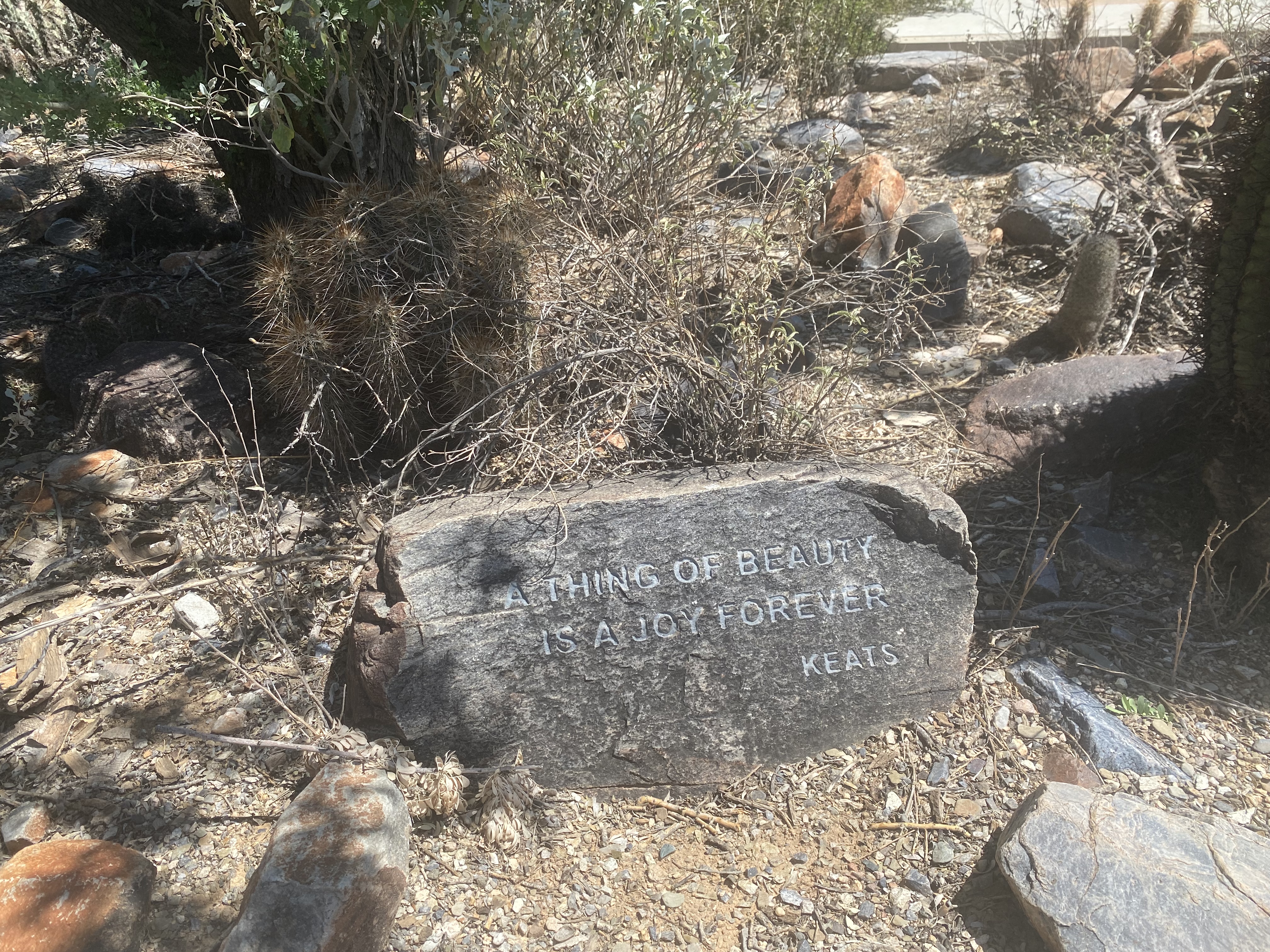

Keats wrote his "Ode to a Nightingale" in a completely different natural setting than the one in which I live. Yet I can sit and listen to the mourning doves and watch the quail go by in a similar state--the sort of melancholy ecstasy that he so well describes. I'm an advocate for enjoying whatever it is that you're able to enjoy where you are. Not that I wouldn't enjoy a trip to England. But I don't believe that beauty is so limited that I can only find it in certain places. 

Like that Keats stone at the trailhead. I only had to take a look, to let my eye linger, to not rush by in order to see it. Don't rush by the hidden odes to English poets. Don't rush by the patch of late summer wildflowers. Don't rush by the extended greenery of the landscape after rain. Don't rush by the tortoise walking the edge of the path. Don't rush by the sparkle of starlight. Don't rush by the fingernail of the moon. Don't rush by the perfect shape of each leaf of that cultivated shrub on that cultivated landscape surrounding that city building. 

For, after all, "a thing of beauty is a joy forever." The city building will not last. The cultivated landscape and shrub won't, either. But the shape of that leaf, crafted by the best designer, will not fade. There will be another leaf on another plant somewhere that will be its match, still crafted in such perfection. Even statues and vases that have been beloved for generations, well, sometimes they are destroyed. The memory of their loveliness sometimes does pass away. And so it is that the loveliness that continues to increase, as Keats describes it, I would say is that found in nature. It is nature that we can keep turning to with joy and awe. And its loveliness increases as our appreciation increases. Stay and linger and breathe it in. 

Monday, May 18, 2020

When Did You Read?

Back when the Internet was young and online shopping even younger, I was enchanted by the idea of C.S. Lewis's Poems because of talk that the volume contained some Narnia poetry. Then being obsessed with Narnia, Poems then seemed like the unattainable portal to more Narnia content. Now that some fifteen or more years later I find Poems in my hands, I'm rather glad that I didn't get a copy of it back then.


There isn't much Narnia content in here. Despite the unicorn on the cover, that angle is covered quite thinly. So if that is your sole reason for coming to this book, well, you'll probably be disappointed in that regard. And I would say you're best off if you're already familiar with several of Lewis's writings, maybe a touch of Narnia but more so with his non-fiction or even at times with The Space Trilogy.

The book was put together posthumously and first published in 1964. It loosely goes by topic rather than year since many of these poems are written at unidentified times. And yet from the content and style, you can begin to guess at what point in his life he wrote them.

You see the young man enraptured by his college studies and writing poems about it all. The imaginative mind dreaming up unicorns and gnomes. Quite frankly, though, reading all this as who I am today, these were the pages I found least interesting. They felt more shallow and uninteresting to my mind at this moment. Better I found the reflections on nature versus industry and the pain of life and love.

Poetry is a very honest art form--perhaps even more so if, like many of these, it is not written specifically with publication in mind. So the titles that show with stark honesty all the pain that we cannot shut away or escape in living are the most thought-provoking. You can see the thoughts that were part of certain concepts Lewis explores in both his fiction and non-fiction writings. While a few of these poems are quite nice on their own, overall I'd say this book's best value is as a kind of companion piece to his other works.

Monday, August 5, 2019

A Glimpse of Edward Abbey

Edward Abbey, kind of like Willa Cather, is one of those authors I've been meaning to get to. There are always so many things to read that sometimes it just takes a while to get to authors you feel like you ought to have read years ago.

As I've been referencing lately the difficulty with having time to sit down and read a book, now seems a great time to bring up poetry. I still haven't read any Abbey books, but now I've read some of his poetry. Poetry is fantastic for the modern reader. Only have two minutes? Perfect; that's enough time for one poem. Have ten? A few poems, then. An hour or two? Hey, you just might make it through the whole volume. You're still getting quality content, just in a quicker-to-read format.


Now, as far as Abbey's poetry, Earth Apples was published posthumously. In his introduction, David Petersen discusses the fact that Abbey didn't consider them great works and didn't try to make them great works--and also that they don't need to be in order to have relevance. My own experience reading them is evidence of that: I haven't, as I've mentioned, read any of Abbey's books yet, but from reading these poems, I have a sense of what type of writer he was. The gist of his style and focus, as it were. I get the idea that I am going to be of two minds about his writing when I finally get to his books. Some of this I much enjoyed, some just didn't resonate with me, and some took the artistic approach that I prefer to leave unexplored.

From the writer's or research perspective, this book is quite fascinating. I don't write poetry, but I do sometimes free write in verse (that's why my latest book does contain some verse). I started doing that in middle school. Then I stopped because I saw that it wasn't poetry and it wasn't good and therefore I thought that it was bad. But I've started it up again more recently because sometimes that's just the way the words want to hit the page. There are many types of writing. And sometimes the writing that you need to do in order to make other, more planned, more perfected writing is simply a collection of thoughts in verse.

Have you ever read the Brontes' poetry? They become known as novelists. Read their poetry and you'll see why. They were not Keats. And yet they're not bad reads and there are some that are quite good and reading them gives this sense of who they each were as writers. You can see a person's style and focus based on how they put together verse.

So let's all read more poetry, shall we? I have a book of John Donne waiting for me and I am still wanting to pick up more Lang Leav one of these days.

Wednesday, August 22, 2018

Lullabies

As nice as it is to just wander a bookstore in search of something, something that you won't know until you find it, something that you won't find unless you go out wandering in search of it, there are always so many books that I already know about that I want to buy that it's difficult to work in the random finds, too. Still, I managed to sneak this one in.


I remember that it was on a display table at Barnes & Noble, but I don't remember what the display was. Something akin to Staff Recommends, I think (not that, but something like that). I was drawn in by the cover. That cover is absolutely beautiful and absolutely me; I would buy that portrait and hang it on my wall. What else is great is that Lang Leav also did her own illustrations for the book, so you'll find a couple more images on the inside.

Now, a cover is one thing and the inside can be another. This is a book of poetry and with poetry, well, it kind of just has to be your style. Either it is or it isn't. And it's usually easy with poetry to open up a book and read a random bit to get a sense of whether or not it's your style. I was so taken by Lang's style that I had to add this book to the ones already in my arms (the ones I'd planned to buy). Some books you just can't let out of your grasp.

"My Heart" and "Patience" are some of the early poems. When I read them, they hit me like waves. I was stunned. When poetry delivers beauty and personal resonance all in one, it just . . . isn't something you can describe. I felt Lang's words shockingly deeply.

Her style mingles poetry and prose. So every so often you'll come across a page or two of prose. "Patience," in fact, is prose. But it's all poetic prose and framed by verse, so it all combines. She writes in a style that's simple yet not stripped bare (which is a style that I don't tend to favor). Intensely emotional while also not sappy (though, granted, if you prefer not to read about emotions, well, then this won't be for you).

Basically these are love poems, some of the high points and some of the low points. That, honestly, isn't really what I'm used to reading. Maybe because of that I feel like I should mention that these words could potentially open up some heartbreak for anyone who might be missing someone, either someone they've never had or someone they once had. At the same time, though, that's kind of the idea of fiction: fiction opens us up and tears us apart and stuffs us with emotions partly ours or ours not at all. The more emotions it stirs up in us, the better we claim it to be.

Well. I suppose I'd better keep an eye out for more Lang Leav books (she has four more out; Lullabies was her second).

Monday, August 28, 2017

I've Walked the Earth

I've walked the earth.
It takes so long.
Here one corner, and there another.
The more I walk, the more corners I find. 
I want to look through them all, to get to know them all,
but the more I look, the more I realize I don't have enough eyes for everything.
For every corner I explore, I have to leave another untouched.
With every turn I take, I am farther from where I began.
At first this doesn't bother me--but then I wonder where I am going in such a hurry.
When can I stop looking?
If I will never be able to reach every corner, then how many corners do I seek before I can go home?
When can my eyes, so eager to explore, finally explore home?
I have seen all the secret places far from where I live.
But I left home in such a hurry that I forget to seek its secrets first.
I've walked the earth.
Then my feet led me back, to walk my own land.

--

I like to travel. I can't say I don't. But I don't travel much and most of my travels have been to relatively nearby locations--and I'm okay with that. Sure, I'd like to branch out some more in the future, but I'm not in any hurry. There are so many more nearby places that I either haven't visited at all or haven't gotten to know very well yet. If there are places nearby to me that I would go to if I were traveling and yet I haven't been to them yet, where is the sense in that?

I want to cultivate the here and now first. When you do that, you can flow more naturally outward to see your place in the greater whole. The city in the county in the state in the country in the continent in the hemisphere in the world in the universe. When I say that I want to focus in on here before there, I don't mean to say that I want to ignore other places; I just mean that you need to have a place that you are directly interacting with on a daily basis. How can you have a good influence on other places if you don't start with your own place?

Wednesday, August 9, 2017

John Keats & the Art of Beauty

Last month I wrote about the emotional quality of John Keats's poetry. I also mentioned that I had been moving slowly (quite slowly) through his complete poems. Actually mentioning this fact of my slow reading made me feel like I really had better just finish the volume instead of dragging it out any longer. Add to that the fact that I have a specific reason right now for wanting to get my voice used to speaking for a long period of time, and I decided to read Keats for an hour out loud every day. Here's to hoping my neighbors couldn't hear me reading out all of his love poems.

Reading in this daily way, like how you would read a novel, proved quite different from reading in order to provide literary analysis. I had no pressure to think of any particular topic or to think with any admiration toward any particular piece. So I easily settled in to enjoying a particular poem or passage--or disliking a particular poem or passage. I didn't care much, for instance, for his experiments (is it bad that I'm calling them experiments?) with plays; while Otho the Great did have its moments, these moments were the times when the lines reminded me most of the regular poems. And I can see why even Keats wrote in his preface for Endymion that certain sections were weaker or better than others; I tended to agree with him that there were some wonderful sections and also some that didn't quite keep my interest.

The greatest power that Keats had, as a writer, was his ability to put together beautiful language. This is why we love his descriptions of nature and of love--they're simple concepts that can fold out into an endless array of images and emotions. So even when he is writing his longer poems that have multiple characters and bigger plot lines, these moments of description are still the best. (I'm not even going to try and give examples because this is just a short blog post; I don't have space to go into more detail.)

But what I also found in this daily reading was the hollow quality of beauty for beauty's sake. Keats intentionally focused on beauty--and the results are indeed beautiful. But when you are focusing only on beauty in, shall we say, a more shallow sense of the word, then the impact can only go so far. You admire how a rose looks and you smell its aroma and then you're done; that's it--it can give you no more. That's how Keats can be. Don't get me wrong; I much prefer Keats to Oscar Wilde. Wilde was also about aesthetics above all else--but in a different way. I think Keats more respected the world around him--and he loved the natural world, which Wilde I think couldn't stand (that quote where he says that manmade chairs are so much better than anywhere you can sit in nature--that just describes every way in which Wilde and I disagree).

Back to Keats. His poetry is oftentimes, as we know, tragic. That's part of what makes it beautiful; we all love a good tragedy. But it's also part of what keeps his work from having deeper meaning. He remarks on beauty but he gives no hope--beauty in itself (this definition of beauty, that is) is not enough to give hope, especially for all of the tragedy that he describes.

I'm not saying that this is a bad thing, artistically speaking. A single poem (or any single piece of whatever kind of art) can only do so much. That's where the reader (or viewer) comes in. We absorb each piece individually for what it offers and then we put them together in our minds. This artist shows us this and that artist taught us that and so on--until we have our heads filled with art in all its contexts. We look at pretty things and we feel different emotions and we ponder different themes--and then we draw conclusions and live our lives, with all of this art sitting somewhere in the background.

"'Beauty is truth, truth beauty,' -- that is all / Ye know on earth, and all ye need to know" ("Ode on a Grecian Urn") That is what beautiful art tells us, but it is not what we know when we are done admiring said beautiful art.

Wednesday, March 29, 2017

Before Winter: The Second Volume

Last year, I fell in love with a random book of poetry that I found at a thrift store; it was The Popular Tree by Clara Emily Guion Aguirre. That book spurred me on to seek out more poetry of the Southwest and thereby reignited my interest in poetry. I remembered that I like poetry that deals with the imagery of nature--that's one of the reasons why I enjoyed reading works from John Keats and William Wordsworth and the rest of the Romantics, even if they were writing from such a different time period and setting.

Clara also had a second volume published, Before Winter. Because these are obscure books, the price that they show up at online varies (I say online because there is almost no chance that you will run into them in person). After enjoying The Poplar Tree so much, I was disappointed to find that Before Winter was just too expensive to buy, but I kept an eye on it and eventually it became available for just a couple of dollars. (The message: keep up hope and keep checking back and eventually you should be able to get the obscure books that you want.)


The first book was published in 1988; I believe this one is from 1992, which was just five years before Clara died (she was born in 1906). A little refresher: she was born in New Mexico but moved to Texas after she got married and lived there for the rest of her life. Now, this second volume is larger and contains more poems than the first one, but it seems to me that these are all newer poems. One of the things I found so interesting about the first book was that it spanned her life, from youth and new marriage and motherhood through to old age. The poems of the second volume aren't dated, but they do all seem to be written from later life; that's what their themes and content imply.

That is, you can tell as much even from the title. Before the winter that ends life. Clara knew that her days were coming to a close. While The Poplar Tree also had some sad content, overall this one is more somber. There are many poems in here about the loss of her husband, possibly too many because the theme does become repetitively melancholy, which takes away from Clara's talent as a poet to show her understanding of life as a whole.

She does show this in other poems, though. Many reflect on youth versus age. The seasons. Nature versus modern (housing, food, stores, etc.). There was a lovely poem about a volcano, "Eruption" on page 129; I've always loved the imagery and symbolic qualities of volcanoes. So, like with her first volume, there is still a lot of focus on nature; it's just less specifically southwestern this time. For instance, she writes often about the sea in here (often being at least a few times). I forget that Texas does have a coast. And that very interesting to me: I am also interested in both the Southwest and the sea, so these poems offered me the chance to look at how someone else united the two.

There are more poems in this volume, and because I found that their quality varied (with some being quite good and others more mediocre), I'm guessing that that means that these were edited down less. Especially if the first volume was selected from almost her entire life, while these were mostly taken from poetry she wrote in her last few years, then that may be a possibility. As I mentioned, some of them were a bit repetitive and would therefore have appeared better if there were less of them. So I may have enjoyed the first book better, in a way.

But that isn't to say that I didn't also enjoy this one. Right away when I started reading, I felt that same connection to Clara's writing that I'd felt before; it's something about her perspective and what she sees and what she chooses to see and the simplicity and beauty with which she describes the world and its truth. There were some stunning pieces in here. "Strange Kinship," for instance, on 204-205, or "My Faith" on 207, just to name a couple. Clara understood the world and she understood life, and so in reading her poetry, I'm reminded of the truths that I know. There is a beauty in the various steps of life and a harmony in knowing how it all works together, and she managed to capture that. Truly, her poetry is some of my favorite. Poetry is like that: it must speak directly to you, otherwise it doesn't matter how famous it is or what literary devices it uses if it doesn't convey to you.

Wednesday, September 14, 2016

Red Earth

Sometimes the word "poetry" does not fall off the tongue well. To say that I like reading poetry sounds odd, like something I wouldn't want to admit--or like a phrase that doesn't quite convey what I might mean if I were to say that. The thing is, poetry is so personal, more so than prose. There are so many forms and approaches that poetry can take, so tastes in poetry vary just as much as (if not more than) tastes in novels.

I'm settling into what kind of poetry I like, and so I am having less difficulty in saying the word "poetry." In college, I favored the Romantics (I still love to pick up my Complete Works of John Keats when I need to read his words), and now I favor the poetry of the Southwest. In April I read Clara Emily Guión Aguirre's The Poplar Tree and in May I read Ofelia Zepeda's Where Clouds Are Formed and now I have just finished Alice Corbin's Red Earth. I picked this one up at the museum shop at the Palace of the Governor's in Santa Fe.


What is, first thing, interesting to note when considering these three poetry collections in the same sentence is the difference in the writer's backgrounds. Aguirre and Zepeda were/are both from the Southwest. Corbin moved to New Mexico in 1916 as an adult for her health--and then quite fell in love with the region and its peoples. Though she became an advocate for preserving and encouraging the local arts, she was a "white" newcomer. This makes her approach to her poems significantly different from Aguirre's and Zepeda's.

Because of all of this background, you will definitely want to read Lois Rudnick's Introduction to this reprint of Red Earth. She talks about Alice's life and her influence on literature and on Santa Fe. She also gives some interpretation on the poetry and discussion of context and certain "complications" that arise when an outsider attempts to represent a culture. Perhaps I shouldn't say outsider, but that's the simple way of putting it: Alice Corbin seemed to really appreciate the lives and cultures of the people she met in Santa Fe. From them, she gained a new perspective and a new way of looking at life.

She conveys these discoveries within this poetry collection. The tone, I would say, isn't quite as soft as Aguirre's, nor as sacred as Zepeda's. But these poems do also contain appreciation and gratefulness for what the earth and life offer. As Rudnick points out, there are various styles in the different poems. Because Corbin had spent so much time in modern literature before moving to the Southwest, she's able to bring a certain style to the familiar places and imagery that you don't usually come across in this context. So she definitely offers something a little different from what I had grown used to finding in Southwestern poetry.

That's about all I have to say for now. Lois Rudnick did such a wonderful job of highlighting the important pieces or lines in this book that I feel like I don't have much to add. I'll just say that my appreciation for this book also grew as I read about Alice's life and opinions. She had a great influence on the art scene and on the preservation of local New Mexican culture. New Mexico is such an inspiring place because of the land but also because there is some preservation and continuation of what people created there and from there. The history of New Mexico is . . . the history of life. The land is life, in all of its circles.