Showing posts with label art. Show all posts

Tuesday, September 20, 2022

Immersive Monet

The question is whether or not one can repeat something twice. When I went to the Immersive Van Gogh exhibit last year, I was intrigued. Granted, I was also in a particular physical/emotional state that may have contributed to my receptivity to explorations of light and color. But I thought it was well put together, "artistic in its own right," I said. I thought it was just a one time thing we were going to get to have for a season. But this year, Immersive Monet and the Impressionists followed. Then there will be a King Tut exhibit. Then The Nutcracker. 

My first thought from all this was that, well, it was good once, but if they keep doing this, are people going to still be willing to pay for those pricey tickets again and again? As someone pointed out to me, though, the newer exhibits are probably to attract a different crowd. Someone who wouldn't have gone to see an exhibit on paintings might go to see a King Tut exhibit. A family who didn't go to the others might go out for The Nutcracker. So maybe people went to see Van Gogh also won't keep going.

I did go to see Monet, though. I had to. I had to check out one more; curiosity gets me that way. I want to see what's been done and what's on offer. There is probably some element with this of the novelty wearing off a second time. But it wasn't just that. This exhibit was composed differently than the Van Gogh one was. Very differently. 

I spoke so highly before of the movement of particular brushstrokes. Well, you can do that with Van Gogh because of the shape of his brushstrokes. They were able to make living paintings with his works. Most of the time with this exhibit, they didn't even try to recreate the effect because you can't. In a couple of instances, they did something similar, which while not the same was still nice enough. I also appreciated things before like the flickering candlelight. Here there seemed to be less "animation" like that. The train let out puffs of steam, so there was that. I would have to sit down with each exhibit and make lists. It's possible that this is just my memory imagining that the Van Gogh exhibit had more animation; maybe they were the same. I can't say for sure; it just felt like less.

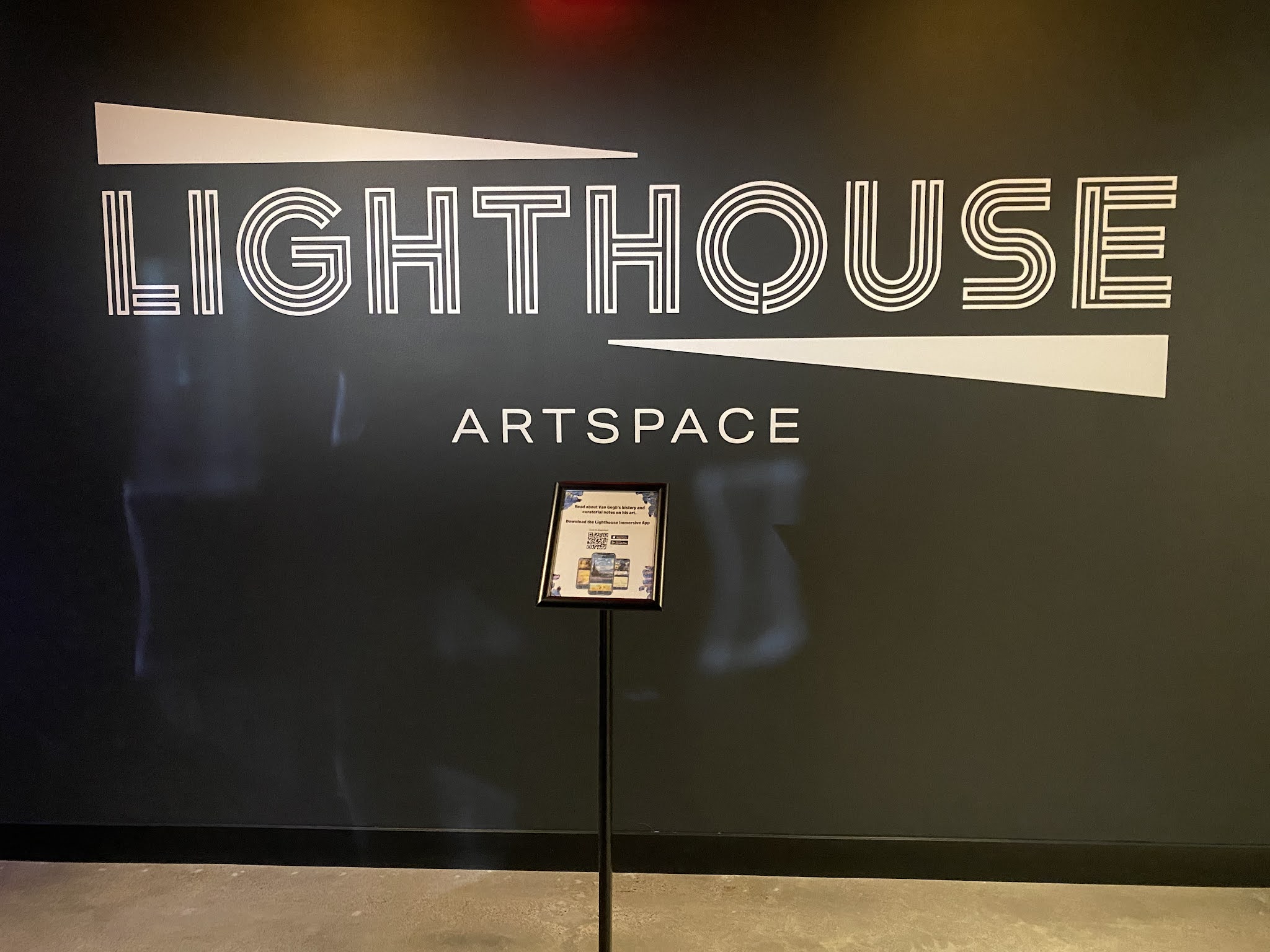
There were sections that were very beautiful. The rolling ocean. The plants and trees coming to life before our eyes. What it felt like, though, was as if certain sections had received more attention than others. Van Gogh felt like we were following a storyline of emotion. Here, we were just seeing paintings cut and pasted in creative ways, with some sections that had more detail. I did enjoy watching it all unfold, and I do like the music that accompanies the exhibit. I get delight out of analyzing things like this. But is it something where if you've seen one you have to keep going and see them all? No, not really. (Granted, this is also taking price into account. If tickets were more affordable to the average person, then perhaps I would be more likely to say that it's a nice little outing to check out whatever is new at the Lighthouse Artspace.) 

So we go back to our original question. Can one repeat something twice? Some experiences viewers can return to again and again. Some creators can keep going and make one movie, one show, one book, one exhibit right after the other--and keep making something as celebrated as the first. But other things are less easily repeated. Is Lighthouse immersive one of them? I'll be curious to see how they do in the future with the new exhibits and whether or not attendance keeps up.

Thursday, November 11, 2021

Canal Convergence Lights Up the Night

A couple of years ago, when I thought about Old Town Scottsdale, I thought of the space south of Indian School Road. On the east side of Main Street were more shops and on the west side more galleries. But lately I've been spending more time above Indian School. There you will find more shops and restaurants and more of the coffee shops and dessert shops. There also, instead of the Civic Center Plaza (which is now closed off for its big refurb), you have the canal. 

The canal is a perfect place to go sit or walk for a bit and enjoy the weather. It's a good place to go by yourself when you just feel like going somewhere but nowhere in particular, or a place to meet a friend. And sometimes there are also events going on. The Christmas lights were lovely last year. But I had never been to see Canal Convergence, which you will find running at night through the 14th. 

I admit I wasn't entirely sure what Canal Convergence was. An art installation and lights, something like that--but what exactly? There were a couple of installations nearer to the street on Stetson Drive, but they really didn't catch my interest. Approaching the canal, there was a big screen showing historic pictures of Roosevelt Dam. The dam and the canals are what allow water and therefore life into the Valley, so they're quite a cool thing to learn about and celebrate. 

And then once you get to the water, the fun begins. They had giant, lotus-like flower lights set up in the water. They put into mind the footage I've seen of ____ at Disney World. And with the bright fingernail moon up in the sky, they were quite pretty. 


Off in the distance, you could also see what were like fireworks blossoming again and again in an eternal loop. The effect of these lights was in fact so impressively similar to real fireworks that I wonder if at some point they might come to replace fireworks in nighttime celebrations. 


There were multimedia sculptures along the path of various animals. The scorpion was cute with an Arizona flag on its head, and the fish I liked because it was a brilliant green. The fish, of course, represents the fish in the canal that help to keep it clean. 

There were also these cool ice cube, marshmallow pieces that faded in and out of various colors. Further, each one had a scannable barcode so that you can control it using your phone. It's a fun, optional digital element that is more directly interactive than some. 

Is there a lot to look at? Not really. But what was there was nice, and walking by the canal in Old Town is already pleasant, so adding in any sort of art or lights is a great excuse to make it a point to get out of the house and see what's up in town. If it's a simple walk to see some fun lights, I'd say that's quite a welcome way to spend an evening. 

Tuesday, November 9, 2021

Immersive Van Gogh

On Saturday I escaped out of my skin. Well, you see, here is how it happened. First I burned the skin of my fingers on a pan (just lightly). Then a cutting board jumped out of the cabinet to slam into the bridge of my nose (my nose didn't break and I didn't get a black eye, so I'm happy, bruise or no). And I was still a little let's jut say loopy after my first acupuncture treatment earlier in the week (I didn't know acupuncture can cause emotional release). The order of these things is all mixed up, but in between the burning of the fingers and the bruising of the nose I went to see the Immersive Van Gogh Exhibit in Old Town Scottsdale.

The exhibit is designed by Massimiliano Siccardi with music by Luca Longobardi. Even though Van Gogh is a familiar artist, the exhibit is an entirely new way of viewing his work. I can't say that I have a lot of experience with digital art exhibits, but it's certainly something that will continue to grow more common. To say that the exhibit involves digital projections of Van Gogh's paintings onto the walls of a room doesn't quite convey what viewing it in person is like. While projections have come a long way in quality in the past couple decades, projections alone aren't enough to provide either freshness or amazement. 

Yet as I sat in this exhibit, I found myself mesmerized. 

I don't know if the setup was slightly different here than it was in Paris or Toronto or if it will be in other locations. Here, you walked through a little corridor and entered a square-ish room where you could stay and watch, or you could continue walking into a rectangular room. Both had the same projections but were fairly different in experience. We were in the square room and only spent a brief time in the rectangular room on the way out just to get a sense of how it was different. The glossy floor of the square room not only picked up the projections better but also had more of them, and the smaller space meant that it was easier to feel like you were literally immersed in the paintings. I think also the room was darker, which also made the colors more crisp.

There is a video loop to the projections. So you might walk in towards the beginning or end or anywhere in between. You can stay for one run through or keep watching. Instead of just seeing the paintings projected onto the walls, you see the paintings made alive. They're not quite animated; that isn't the right way to describe it. If there is movement within the paintings, it is the windmill arms that will turn or the candle flames that will flicker--the people do not move. That is, the paintings of the people might. Faces might drop slowly into the "screen" or fade into view. Colors might change--from dark dawn to rosy morning hues. 

Or one of the most intriguing things that is also so specifically great for Van Gogh is that the very brush strokes might move. Van Gogh uses those fat brush strokes that are each an individual element. So you might literally see the swirly brush strokes of Starry Night swirling about before your eyes. In this way, you find yourself reawakened to color, shape, and light. You begin to see anew the artistry in everything your eye beholds. 

And this is how I found myself mesmerized and removed from my own skin. I was released from the cares of my head with my eyes opened to the beauty of life around me. This is even stranger still given that, while I can appreciate his work, I wouldn't name Van Gogh as a favorite painter. So the work that went into this exhibit--the selection of which elements to "animate" and how to make the paintings move about and how to play with their color and lighting and the way in which the music helped to set up the emotional tone--was carefully executed, artistic in its own right. 

So while this is one of the more expensive art experience, if you have any interest in art it is worth seeing while it's still in town. Originally it was leaving this month; now it's extended until February. 

Wednesday, August 7, 2019

Agnes Pelton

A couple of years back, a visit to the Georgia O'Keefe Museum in Santa Fe left me refreshed and free, inspired by the concept of her artistic vision. Now when I go to the Phoenix Art Museum, I nod to any Georgia O'Keefe, saying, hey, I know you, and I also pause over the Agnes Pelton they have (it's usually next to the Georgia O'Keefe), thinking, hmm, that's a similar style, that abstract style that I can get into. I don't generally like the modern art much and abstract usually isn't my style, except when it's done in this certain way. Makes sense, too, I suppose, given that this was "modern" many decades ago, and so of course it would be quite a different style from what is modern today.

Now they have an Agnes Pelton exhibit going on at the Phoenix Art Museum--in fact, it's almost over, I've just been very bad and only just made it over to see it. Very bad considering that I was quite excited for it.

Again, this is abstract that I can get into. Such use of color and shape. Visuals become emotions. Aesthetics is not disregarded. Talent, too. Delicate shading here versus stark contrast between colors there. Content, as well, was something I favored. The desert makes a beautiful inspiration for art.

As some of the commentary mentioned, as well, there is an almost sci-fi quality to some of Pelton's work. It reminded me of some of Tolkien's art or of the illustrations that have been done for C.S. Lewis's The Space Trilogy. That very natural world and yet very other land look. So I could just keep staring at some of these paintings--they were inspiring and thought-provoking. Some, though, maybe took that edge a little too far for my interests. Pelton had an interest in thoughts and beliefs that would lead in to the New Age category and you can see it in her painting. A couple of her pieces in particular would fit right in at a couple of spots in Sedona. So it was interesting to observe that line: one one side of it I was enthralled and just right on the other I was removed.

It's funny the things that inspire us. I felt enriched from viewing Pelton's work--and yet it is only more recently that her work has been receiving wider recognition. There are many artists like that, aren't there? Sometimes the most famous artists are famous because they resonate on a personal level with so many people. But sometimes you won't overly connect with the work of a famous artist and instead you'll find a lesser known one who inspires you. That's why art is something you can continue to delve into your whole life long--there will always be new things to discover. 

Wednesday, April 19, 2017

Reflections on the Fourth Wall

Lately I have been obsessed with the fourth wall.

The greatest flaw, supposedly, of a book is the last page, specifically the fact that finishing reading the last page pulls the reader away from whatever realness the book created while its pages lasted. Likewise for the dropping of the curtain at the end of a stage production.

But is such really the case? And I'm not just referring to the positive effect that the intentional breaking of the fourth wall (that is, the realm of metafiction) can have on art. I'm talking about what we as the readers or the viewers bring to that wall or ask of that wall or otherwise receive from that wall that enhances our experience.

Let me give some background. Lately (let's say in about the past year) I've been watching a lot of Disneyland videos on YouTube. I stumbled on Fresh Baked and Briberry while looking for Star Wars content. Later I watched the "Confessions of a Retired Disney Princess" video and also found Subway Mouse's channel, Olivia Simone's most recently. I love Disneyland, so naturally I loved hearing behind the scenes stories about how things work/flow or simply who Disney people were and how they came to work there.

(I feel like I should mention here that my intention is not and was not to be creepy or disrespectful. Disney employees and other performers of course have the right to private lives. I don't want to know where they live or where they shop or what they had for breakfast. I just find the voluntarily shared details or the details that you see from observing say one "version" of a character versus another interesting.)

It's fascinating to me to watch these videos and observe that: Wow, that Alice has been there for years, but of course because she's the best one. Yeah, that Hatter was a dancer; he can't hold still, and that was why he brought such great energy to the character. Hmm, so they basically have to be the type of people who always know how to keep a conversation going (or change its course). Oh, is that how they do auditions? Okay, so certain roles like character hosts often go to people who just don't look like any of the characters but still have the personality for it. Look at that, I've never seen any of them break character except for that one time that one boy broke Hatter, Alice, and somewhat Cruella all in one go (Peter Pan didn't break).

Little things here and there. Like seeing how characters recognize certain guests who are there all the time. Or the fact that after watching all of Briberry's videos, you suddenly can tell when the same person is portraying a different character than they usually do--or maybe you even recognize someone out of character. And all of the inside jokes and references to old videos that show how much Disney people love Disney, whether they're in character or out of character.

I have met some characters. Picture from 2013.

The thing is, I never had much interest in the characters at Disneyland. I still don't know that I would be that interested in meeting them, but I have come to appreciate and enjoy their form of live performance entertainment and interaction. It's this extra angle that's gotten me interested. And isn't that often the case? (Though most of this post is about Disneyland, I don't mean to say that my current interest in the fourth wall is only in terms of Disneyland.)

I've always loved watching making of videos for movies, long before DVDs with all their menus of special features came out. I'm talking about the thirty seconds of behind the scenes that would play at the end of some of the Wishbone episodes, or the feature that played at the end of the Wizard of Oz VHS or the ones that played before the Special Editions of the Star Wars VHS trilogy.

And sometimes when you finish reading a book, you don't react in shock that you're pulled out of that world and back into reality. Instead, you go seeking more emphasis on the fourth wall. You read the author's afterword, or a scholar's introduction. Maybe you seek out the author's biography.

The awareness of fiction's state as fiction does not detract from the experience; rather, this awareness and interaction with this awareness often enhances the experience. It gives you an extra layer (or many extra layers) through which to view this piece. Though you lose the sense of reality that comes with forgetting that the piece is fiction, you gain the tangible feeling of something that was created in the real world by real people.

They created something and gave it breath; you looked and saw that the breath was fake; but then you looked and saw them breathing their own breath into this fake thing; and then you saw how the real breath made the fake breath alive.

That's creation, isn't it? And art is creation.

Wednesday, February 15, 2017

A Reflection on Symphony Hall

I guess this is just my week for long, rambling posts. Apologies.

If you've only been to Symphony Hall in downtown Phoenix once, chances are it was for a Christmastime performance of Ballet Arizona's The Nutcracker. They put on a wonderful performance, with many, many shows each year--and it's supposed to be one of the best productions of this ballet in the nation. I can see why: the dancers are talented, so many elements are timed to perfection, and the sets and costumes are detailed and beautiful. So if this is the one event that brings people to Symphony Hall or to go see a ballet or to hear the Phoenix Symphony live, then that's great and I'm certainly not complaining about that.

I'm just wondering about something.

This past week, I went to see Ballet Arizona's Romeo and Juliet. Not because I'm the biggest fan of the story of Romeo and Juliet but because I wanted to finish off this run of shows I've been going to see with just one more for now. Plus, it was the third medium: two plays, an opera, and then a ballet. I had to round it off. Now, I'm not going to give a general reaction to the ballet this time; instead, I want to consider something that I observed about the audiences at these shows. (Reminder: this is the Phoenix area. The audiences here are obviously going to differ greatly from a show in, say, New York.)

The plays draw people for different reasons. A lot of retired people. A lot of college looking people who are probably seeing it for a class or because they're feeling particularly cultured and educated right now and therefore going to see a play feels like the thing to do (and because they get tickets for the price of an IMAX movie). So a quieter, more niche group.

The opera, as I mentioned before, brought in the classy people. You can tell when there are people with money in the room--people who are letting that money show a bit tonight because it's the opera and they wanted to dress up and they paid hundreds of dollars for their tickets. Other people really want to be there and are really excited to be there because they really enjoy the experience of the music and the singing; so these people, given that they've probably been planning this night for a long time, also put a lot of thought into what they were going to wear. Maybe they even went out and bought a new dress. In general, they're artistic people with taste--so that shows in what they choose to wear. Simple elegance. I'm not saying everyone was wearing diamond tiaras or that I think everyone should have been; I'm just saying that everyone, in their own way, put themselves together for this night. I want to try and guess that the age range was more around 30's through 60's for this one. Not as many white-haired heads in the crowd, and also not quite as many very young faces.

Now, when you go see The Nutcracker, you get quite a variety of ages and types of people, and it was pretty much the same for Romeo and Juliet. Maybe not quite as many families this time, but still a similar scene. There were children sitting in the seats near me ranging from probably about nine years old to fifteen. Still plenty of adults, ranging from the very young to the less young to the more mature and so on. People who looked monied. People who looked like they just really wanted to come see this show. People who looked artsy. People who didn't. The dress style? Much less formal and therefore a bit less elegant. More like "church clothes." Whatever you have in your closet that looks presentable. (I feel like I'm starting to sound borderline rude here. I don't mean to say that you should only go see a show if you buy a new outfit; I certainly didn't do that. Nor do I mean to suggest that clothing is the only thing that matters.) Basically what I'm getting at is that the crowd was more varied at the ballet than at the opera, and I'm wondering why.

I know that people make fun of opera, in a way, and most people can't imagine going to see opera. But people kind of make fun of ballet, too. So why do more types of people consider going to the ballet than to the opera? I enjoyed the ballet, but I vastly preferred the opera; it was in fact the opera that held my attention more and moved me more. I know everyone won't feel the same way, and of course our reactions also vary depending on the particular opera or ballet that is being performed.

But here's the thing. Music, singing in particular, resonates with people on a deep level. This is why you can listen to a song in another language, without knowing what it means, and feel what the song is saying and what the singer is portraying. Dance resonates, as well, and of course there is music to dancing. But if modern people don't listen to much opera, they also don't listen to much symphonic music. So I would imagine that most people who aren't musicians who are going to a ballet are seeing more of the dancing than the music. And dancing is fascinating to watch. The choreography, the athleticism, and the emotion of movement. It is wonderful, yes. But for me, it was easier to focus on the emotion of song for over two hours than the emotion of dance.

In general, I enjoyed the group dances more than the pair dances, even though I felt like my favorite parts should have been the dances between Romeo and Juliet since it is their story. The fight scenes were probably my favorite; I had never seen ballet sword fights before. I guess I mainly liked when there was more to look at, more places for my eyes and my head to wander. And maybe that's why some people would sooner go see a ballet than an opera.

I didn't like my mind wandering; when I lost focus, I took that to mean that I wasn't enjoying the show as much as I might have liked to. I said that the opera took my full attention for all of its duration--but that was because the music touched me. And if other people feel like they won't be touched by the music of opera, then when their attention wanders they won't have much else to focus on. The singing is the star of an opera. Some attention goes to costumes and sets and I guess some operas have more choreography to look at. But the two operas that I've seen have had a much simpler stage than the elaborate productions by Ballet Arizona (I said I wasn't doing a reaction post, but I have to add in here that the backdrops to Romeo and Juliet were absolutely gorgeous, and I loved all the dresses).

When your mind wanders at the ballet, there are multiple things to focus on. When your mind wanders at the opera, there is less.

This is why the audience crowds differed. There were more types of people at the ballet because they were there for more reasons. The opera crowd was mainly there for one reason: we knew that we would be moved by the singing. Some perhaps because they grew up with the "culture" of fine arts and don't see opera as a foreign genre, and others because they discovered later on that this music speaks to them.

I'm beginning to understand this much: performance is art. When I go to the art museum, I spend most of my time looking at the European and American art from medieval times through the 19th century; I walk into the modern rooms only to quickly walk out again because the art there doesn't speak to me, even though I see people there who are mesmerized. Performance is the same way. We all find what speaks to us and realize that we prefer certain things over others. The main thing is to go ahead and look. Walk into the modern art section just to see if it speaks to you. Go to the opera just to see what it's like. If it doesn't speak to you, then that's okay; find what does. But it's fascinating to see all the many reactions we can all have to the same piece of art and the ways in which we settle on the art that we're comfortable with.

Monday, June 9, 2014

On the Meaning of Art

I usually have a bit of an issue with Oscar Wilde--and with the aesthetes in general. I can't feel that aesthetics are all there is to beauty and therefore to art. Art involves aesthetics, certainly, but I can never place as much value on aesthetics as Oscar Wilde and others do. I consider art expression as well as beauty--and the expression itself can be beautiful, apart from straight aesthetics.

But then we run into another question: whose expression? Is it personal expression, as in the expression of the artist? Does that mean expression as direct from the artist's perspective or not? Is it expression of the character/speaker/etc? Is it expression of a culture? How much separation is there, after all, between the artist and the speaker and between the artist and the culture? It's a web of lines, intertwining back and forth, and that perhaps is why people have such differing explanations of what art is.

Art is vision given physical form. Physical form can, of course, also mean words: it's the distinction between things within and outside the mind. Aesthetics, on their own, have no vision. The shape of a circle is aesthetically pleasing, but without vision it is nothing. The small metal mirror hanging on the wall in front of me is beautiful not just because it is a circle; it is beautiful because it is handmade, shaped into perfection and punched with a pattern of small dots and delicate edging; it is beautiful because of the hands that made it.

That's why not everyone agrees about what is beautiful: beauty is more than aesthetics. And if art were simply aesthetics, artists would have run out of creation long ago. I see beauty when I look outside, at the shades of brown and white and yellow and green that stretch toward the mountains of blue that look up toward the broad and bold sky. Someone else sees beauty in the curved metal of their car. We can both see that the other has a valid concept of beauty, even if we don't see things in the same way. And that is where the expression side of art comes in.

Art is aesthetics with the personal perspective added in. Art isn't just the artist speaking to you directly out of their thoughts. But it is shaped by how the artist sees the world. I am of the land and any art that I create, in some way, expresses that identity. Some artists love simplicity and clean lines, and viewers who love the same will connect with their art and enjoy it.

That's what it's about: the artist connects with the art he creates, and then the viewer connects with the art the artist has made. It's about connection . . . so then art is language. Language is a collection of forms and rules but only receives life from the mind that controls and forms it.

Monday, July 2, 2012

On the Meaning of Art

Often I say that I have the same taste in books, music, and movies, probably with art included, too. I feel like I am always responding to the same types of things, whether in the form of a Flyleaf song or a Charlotte Bronte novel. Things may appear very different, but they may have different coloring when viewed by my eyes.

And so this brings me to the origins of art and also to its purpose. I have come very much to dislike Oscar Wilde's statement in the Preface to The Picture of Dorian Gray that "all art is meaningless" and its only value is in its beauty and aestheticism or some such thing. I disagree: art has meaning to the creator because its creation is a process (one that often comes with healing or other such products), and art also illuminates anything from an individual's experience to a society's particular (or not so particular) traits. All societies have art, in one form or another. And even tasks like planting seeds and building a basic chair have art to them.

So when it comes to art like the first four forms I mentioned (the usual books, music, movies, and paintings/sculptures/etc.), how do I like art to arise? Should it come free of itself? Should it come with intention and plans? Should it have a specific purpose or message? Should it be a question?

I think it can be any of these things, or any combination of them. Some art is very purposeful, like a documentary probably is. The director sets out with the intention to enlighten the world about a particular subject, but probably also learns some new things himself along the way (and some would argue that the thing the director learned is what made his documentary art). Or you could reference Tolkien, who set out in The Lord of the Rings to create a British mythology; but even he, he who liked to be in absolute control, built off of things like languages that had been forming in his mind for years.

That's why I think "expression" is the perfect way to describe art. An author may not know what his story means while he is writing it, but it's flowing out of his mind so that he must let it take physical form, just as human beings have always found a way to communicate no matter in what language. Somethings expression is to a certain aim and sometimes it isn't; most often, I think it is both.